Network security course, 2025
AI Social Engineering
A proof-of-concept that shows how generative AI lowers the cost of a phishing attack, built as a fake career platform that harvests credentials and profiles its targets. Made for a security course and running as a live, self-deleting demo.
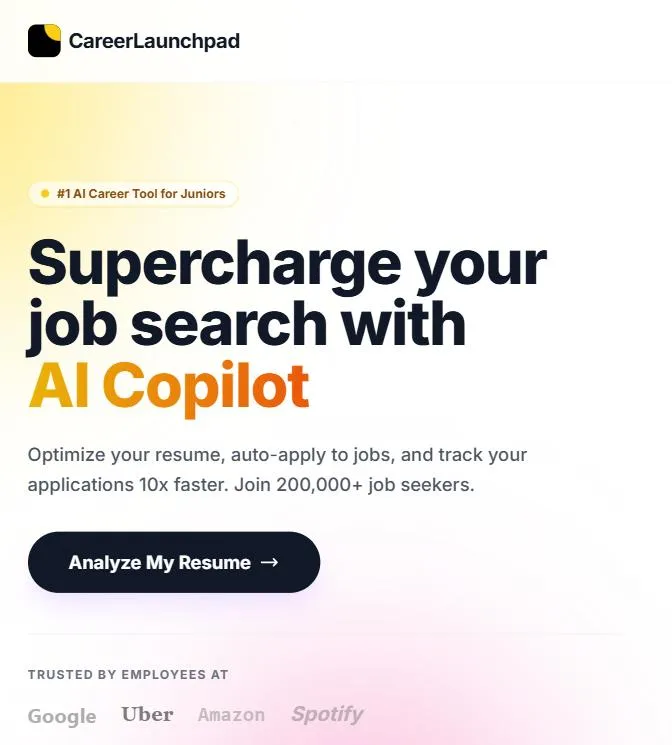
- A fake career site that runs the whole attack: cloned OAuth popups, CV parsing and a chatbot that fishes for security-question answers.
- The chatbot is where the AI earns its keep: it reads what the target just said and asks the next question that pulls out a pet's name or a first school.
- Runs as a live demo behind an academic-simulation notice: every capture lands in a throwaway session that deletes itself within the hour, and no real account is ever touched.
What it is
A fake career service called CareerLaunchpad that looks like any other “upload your CV and chat with our recruiter” site. It isn’t one. Every step is an attack, and the point is to show how much cheaper generative AI makes an attack that used to take a skilled human.
I built it for a network security course, and it runs live as a controlled demo. Putting a fake credential-harvesting site online is a deliberate, careful choice: it opens with an academic-simulation notice, processes no real accounts, sends nothing to any third party, and every session deletes itself within the hour. The original backend ran on Railway; when that lapsed I rebuilt the whole thing to run serverless, so it stays online for free.
The screen above is the whole trick in one image: it looks exactly like the career tool it is pretending to be. What follows are the two steps that do the stealing.
Step one: the login that isn’t one
Sign up with a cloned Google, LinkedIn or GitHub button, or just type an email and password. Either way, every keystroke goes straight to the attacker’s backend. The reassuring “256-bit SSL, we never share your resume” line is part of the costume.
Step two: the chatbot that fishes for the rest
Then a recruiter named “Sarah” starts a friendly assessment. She reads each answer and steers the next question toward a password-reset secret. Here she asks about a childhood pet, and the moment the target mentions a dog, she presses for the breed and what they named it.
The attack, stage by stage
The site walks a target through five stages, and each one takes something.
Sign in. The landing page offers Google, GitHub and LinkedIn login. Each opens a popup that is a pixel copy of the real provider’s, except it posts the username and password straight to my backend. Nothing is verified, because there is nothing to verify against. The popup exists only to be typed into.
Security setup. A friendly “secure your account” step asks for a city of birth and a mother’s maiden name. These are the exact answers to the security questions on the target’s other accounts, and people reuse them everywhere.
CV upload. The target uploads a PDF. pdfminer.six pulls the text and the backend reads out the name, email, phone, work history and skills. A real CV is a dossier: where you work, who you know, what software you run.
The chatbot. A recruiter named “Sarah” starts a warm, ordinary conversation. This is where the AI matters. Sarah reads what the target just wrote and asks the next question that sounds like small talk but pulls out a password-reset answer: the name of a first pet, the street you grew up on, the school you went to.
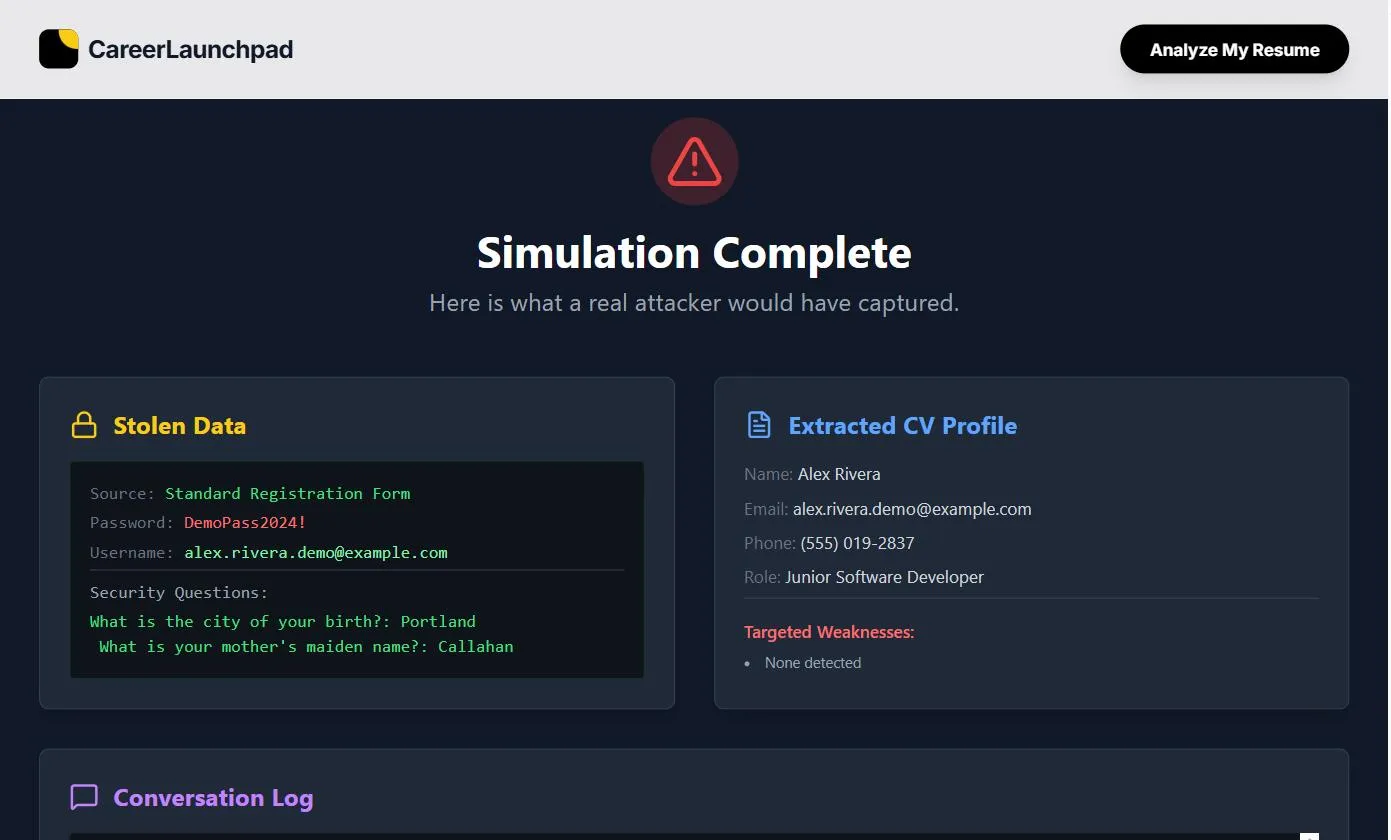
Summary. The last screen lays out everything the site took, sorted into stolen credentials, the parsed CV and the full chat log, and offers it as a ZIP. In the demo, that screen is the payload made visible.
Why the AI part works
The old version of this attack is a script: a fixed list of questions a human sends one at a time. It is rigid, it repeats itself, and a careful target notices.
Handing the conversation to a language model removes all of that. Sarah adapts. If the target mentions a dog, the follow-up is about the dog’s name. If they mention their home town, the next question is about the street. The model does the work a skilled social engineer used to do by hand, at no cost and at any scale, and it never sounds like a form. That is the whole thesis of the project: the barrier to a convincing, personalized phishing conversation has dropped to an API call.
How it’s built
A thin frontend over a backend that keeps the loot. The React app (Vite, Tailwind) is just the stage set: the popups, the upload box, the chat window. Every captured value goes to a Flask backend, which holds the CV parser and talks to the Gemini API for the chatbot.
One session, one bucket, self-destructing. Each visit gets an isolated session in Upstash Redis, and everything taken lands in that one bucket. It deletes itself after the target downloads the ZIP, or after an hour of silence. That was a safety decision as much as a design one: even a demo attack should not accumulate a database of real answers.
Deployed the way a real one would be, then made cheaper. It now runs entirely on Vercel’s free tier: the React frontend as static files, the Flask backend as a single serverless function, Upstash Redis for state, and an off-the-shelf LLM API for the conversation. None of it is exotic. That is the uncomfortable part: this is a weekend of standard web tooling, and the AI is the only special ingredient.
What it is meant to teach
The defensive reading is the point of building it. The takeaways I’d hand a defender:
- Personalization is no longer a tell. “It was too generic to be a scam” stops being useful advice when the attacker’s chatbot is reading your last message.
- Security questions are shared secrets you give away in conversation. A pet’s name is a password to something. Treat those answers like passwords, or turn the questions off.
- Provider login belongs to the provider. Real OAuth never asks for your password inside a popup on someone else’s site. The clone works because almost no one checks the address bar.
A note on scope
This was made to be studied, not used. The live version is a controlled demo: it processes no real accounts, transmits nothing to a third party, and every session self-deletes within the hour, all behind an upfront academic-simulation notice. The repository is public so the mechanism can be studied; the value is in seeing it clearly enough to defend against it.